The Work Behind the “U”: How UM Cheerleaders Keep Campus Energy Alive
While fans see smiles and stunts on Saturdays, cheerleaders describe a year-round grind of practices, appearances, travel and pressure to stay perfect on camera.
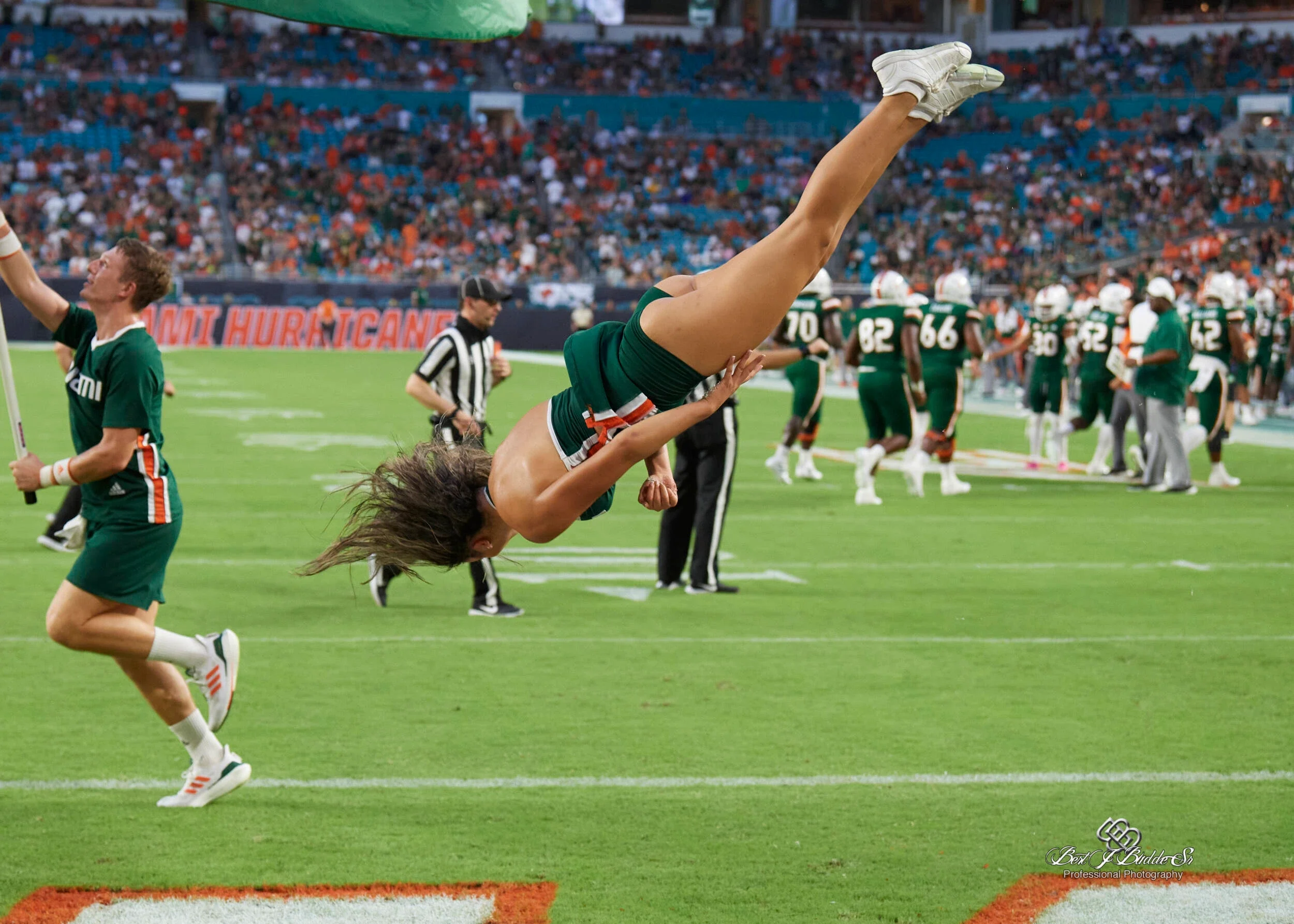
By Sumner Bradley
While much of campus winds down after classes end, UM cheerleaders are clocking in. Penelope Gilbert, a senior and fourth-year member of the cheer team, says her schedule is built like a job, with consistent weekly shifts and early-morning training that continues even when most students are asleep.
Some students run on Dunkin’. Others run on cafecito. But at the University of Miami, school spirit runs on cheerleaders.
For Gilbert, cheerleading is not simply a campus activity or a weekend commitment. It is a year-round role tied to visibility, pressure and responsibility, one that extends far beyond the sidelines. Her week is structured around three long evening practices and early-morning lifts that require discipline most students do not see.
“We practice Monday, Tuesday and Thursday from 6:30 to 9:30 p.m.,” Gilbert said. “That 9:30 is kind of a guide. We usually go a little bit over that.”
Games are only one part of what the team does. During fall semester, cheerleaders cover football and every home volleyball game, with training continuing between weekends. Off the court and away from Hard Rock Stadium, they also represent the university around Miami at promotional appearances that add more hours to a schedule already packed with practice and academics. Gilbert said the events range from public appearances to private celebrations, including requests for birthday parties and weddings.
Those appearances are tracked through a points system that determines whether cheerleaders receive an end-of-season stipend. Gilbert emphasized that the compensation is limited and not comparable to hourly pay, but the requirements to earn it are strict: 10 hours of additional promotional appearances, counted through “promo points,” earned by the hour.
The workload peaks when most students assume cheer slows down. Competition season, especially the lead-up to UCA College Nationals in January, takes over winter break. The team stays on campus for most of the holiday, leaving briefly before returning around Dec. 28.
Winter break practices run like shifts. Gilbert described two-a-days that keep cheerleaders in the gym all day, usually starting in the morning, breaking for lunch and returning for a second session in the evening. The repetition, she said, is what makes the performance possible. UCA routines are built on precision, and the margin for error is thin because the team only gets one shot.
“It takes that much really to put together a college cheerleading routine,” she said. “No one really understands the amount of repetition it takes to hit a routine at UCA College Nationals when you have one chance.”
The pressure does not end when practice ends. Mistakes rarely stay private in a stadium full of phones. Gilbert said one slip can travel fast, especially online.
“People don’t realize how important it is for us,” she said. “I mean, one slip up … a student is recording. Next thing you know, we’re on Barstool Miami.”
Barstool Miami is a popular social media page that reposts viral Miami nightlife and sports clips, meaning a sideline mistake can quickly become public.
That microscope extends to appearance. Cheerleading is performance, and performance comes with expectations. Gilbert said she budgets time to get ready on game days because hair, makeup and presentation are part of how the team represents the university. At the start of each season, she said, the team attends a makeup seminar with an artist who gives product recommendations and advice for staying polished through heat, sweat and halftime touch-ups.
The work becomes most visible during football season. Gilbert said the atmosphere at Hard Rock Stadium has shifted since her freshman year, Cristobal’s first season, when the Hurricanes went 5-7 and crowds felt quiet.
“I think this season has been extra special,” she said. “My freshman year was Cristobal’s first year. That was the season that we went 5 and 7, and Hard Rock was always kind of a little dead and our fans weren’t really in it.”
This year, she said, the energy felt different: fuller sections, louder noise and a fan base that stayed locked in week after week.
The playoff moment hit during practice when her coach pulled up the selection show. Gilbert said seeing the Hurricanes appear in the bracket changed the mood immediately.
But Miami’s postseason run did not simplify the cheer team’s responsibilities. It complicated them. Football pushed deeper into January while cheerleaders continued preparing for nationals. During the playoffs, travel selection was limited, with only 24 team members allowed to go.
Travel itself operates like a production. For regular-season road games, Gilbert said the program uses charter flights and typically sends two planes. The process starts at the athletic center, where athletes go through TSA before boarding a bus that drives directly to the plane on the tarmac. Cheer travels separately from football on what Gilbert called the “auxiliary plane,” alongside administrators, media and equipment staff.
The overlap between playoff football and competition season was most intense during the Fiesta Bowl in Arizona. Gilbert said deciding who to send was difficult because the team was “in the thick of competing,” with nationals less than a week away. Even out of state, the cheer team kept practicing: coaches rented a cheer gym in Arizona, and the group held full-length practices on Tuesday and Wednesday ahead of the Thursday game.
By the time Miami reached the College Football Playoff championship, the atmosphere shifted again. The stage was bigger, the crowd louder and the spotlight harsher. A stadium filled with cameras, phones and national attention, where cheerleaders were expected to project energy through the final whistle, regardless of momentum on the field.
The crowd also surprised her. Gilbert said the championship game felt dominated by Indiana fans, which changed the sound of the stadium and the energy in the stands.
“The championship game, funny enough, even with it being at home, was mostly Indiana fans,” she said. “I would call it like 60 or 70% Indiana fans.”
Now, Gilbert is nearing the end of her college cheer career with a mix of relief and sadness. She called it a strange feeling to step away from something that shaped her college life and demanded so much of her time.
“This has been my life for the past four years,” she said. “Seeing these people almost what feels like every single day, it is going to be such a weird adjustment.”
As she looks toward graduation, Gilbert said she is already thinking about what happens when the schedule disappears.
“I’m wondering if when this is all said and done, am I going to have the discipline if I wanted to get up and workout at 6 a.m.,” she said. “Just for myself.”